Up at 6 o’clock after a poor night. Only one walking case to take down. Talked a good bit with Mark Jackson. A fair number of shells came over but we managed all right.
Somersets went over the top on the left.
Up at 6 o’clock after a poor night. Only one walking case to take down. Talked a good bit with Mark Jackson. A fair number of shells came over but we managed all right.
Somersets went over the top on the left.
Up about 7 o’clock. Had breakfast, packed up kit and went up the line in the car to spoil bank and then walked on to right† post. Had quiet journey up and quiet morning. Not much doing all day and no cases.
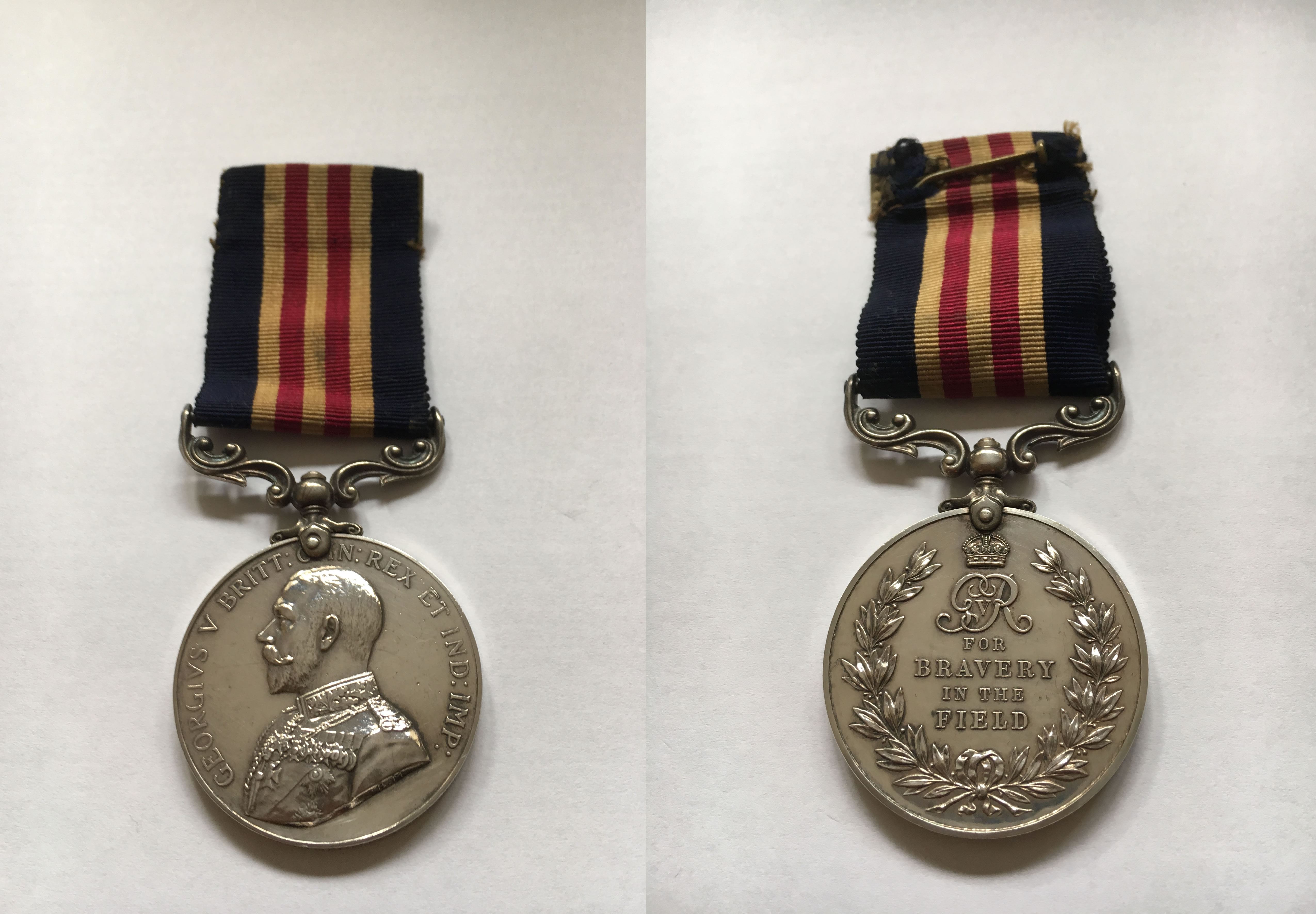
Up at 7 o’clock. Went up on the car to spoil bank on working party and stayed until about 3 o’clock. Rode down on two lorries. Ernie waiting for me. Harry Bascombe looked after him and got him tea. Ernie stayed to the beginning of the Y M service. He was wearing the Military Medal. I set him up the way back to the brasserie, and we talked all about my leave and all the rest of it.
Saw Ernie first thing after leave and he was wearing the Military Medal.
Up about 7 o’clock. On fatigue all day [“morning” written above, but “day” not erased]. Got pass to go and see Ernie in the afternoon. Walked to Dikbush and when I found the place he wasn’t there. Got tea with them and left about 5 o’clock, after speaking on the telephone to Ernie. Walked back by La Clytte and called in to Y M C A. Got back about 8 and wrote to Charlie but didn’t get letter finished. Warned for working party in the morning.
MILITARY MEDAL

Mrs E. W. Linfoot1, of 16, Nelson Street, has received a letter from her husband, Bomb. Linfoot, R.G.A., intimating that he has been awarded the Military Medal for bravery and devotion to duty on October 4th. Bomb Linfoot was an assistant with Messrs Hills and Co., stationers, Fawcett Street, prior to joining the Colours in May, 1916, and has been six months in France.
Up at about 7 o’clock. On fatigue all day. Wrote part of a letter at night to Charlie. Called in at Y M.
Up at midnight. Breakfast 12.15. Paraded for rations 1.15. Fritz1 plane over and delayed for an hour. Marched to train 3 o’clock. Got into compartment with only one door. 12 hours on the journey. Arrived at Bailleul about 3 in the afternoon. Had dinner and got a lorry to Locre. Walked from there to Kemmel2 and arrived just after 4 o’clock. Commenced to write letter home, fine day, looked through letters received. Harvey and Holman up the line.
Arrived at Ambulance after leave.
Up about 7 o’clock. Breakfast and then paraded. Dismissed until about 1 o’clock. Wrote a letter home and one to Everyman1. Got on the boat shortly after 1 o’clock. Very good crossing and I enjoyed it. Big escort both in the air and sea. Marched up to Saint Martin’s camp2 in time for tea. Detailed off. Spent part of the night in the Y M and sent off a field card. Reveille at midnight.
More on this letter to Everyman in a later entry. See also Everyman and Arthur Linfoot’s Library. ↩
“Saint Martin’s camp”: one of several army camps in and around Boulogne. The map shows this part of ALL’s journey, from Folkestone (A) to Saint-Martin (B). ↩
Arrived at London at about 6 o’clock after a fairly good journey. I managed to get a bit sleep. A lot of sailors in the train and they were a jolly lot. Arrived at Folkestone – after crossing London – about 9 o’clock1. A strong wind and sea so we were put into billets on the quay. Wrote letter home and allowed in the town in the afternoon. Made a few purchases, sent off some postcards and had a nice little tea. Met Clifton† and the R F C men and went out again at night. Glorious sunset and bonny night. Slept pretty well. Had long talk with signal engineer. He has been recalled after only 36 hours’ leave.
The map shows this stage of ALL’s journey back to France from London (A) to Folkestone (B). ↩
↑ Full entries in pencil resume here. ↑